

The Heckman Curve, Applied
The Heckman Curve summarizes decades of groundbreaking research by James Heckman, Nobel Laureate in Economics, on the real impact of investments in child health. The Heckman curve compares investments in child health during developmental stages to the returns generated in personal achievement and social productivity (labeled on the chart at “human capital”). Dr. Heckman’s analysis proves what we intuitively know to be true: the advantages a child experiences during the first years of life compound over a lifetime. Newborns who are born to healthy parents, in a safe and stable household, who have access to food and healthcare, loving relationships and nurturing experiences are significantly more likely to grow into healthy, stable, productive adults.
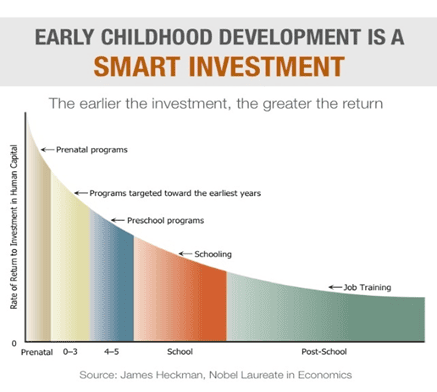
| Investments in children result in adults who are: – Healthier – More educated – Less likely to interact with the criminal justice system – More likely to earn higher incomes – More likely to contribute to the tax base |
But focusing on the longitudinal promise of the Heckman Curve can overshadow the immediate benefits of investment in early childhood development. In reality, these short-term investments maintain long-term value in the life of a child. For example, investments in increasing access to inter-conception and prenatal care have returns that accrue immediately in the form of reduction of unplanned pregnancy, reduced economic hardship, and healthier conception and prenatal development.
Read on for more examples of how leaders in government, health care, education and social services are applying the Heckman Curve to drive measurable results for children today, and for a generation at large.
- Milwaukee Succeeds – A collective impact initiative in Milwaukee, WI to prepare every child for educational success, from cradle to career.
- Tennessee Books from Birth – An early literacy partnership between the TN Governor’s Foundation and Dolly Parton’s Imagination Library that provides free, age-appropriate books each month to all enrolled children from birth to 5 years.
- Triple P – Positive Parenting Program – A parenting and family support system designed to prevent – as well as treat – behavioral and emotional problems in children and teenagers, and support a stable and cohesive family life.
Genesis Health Consulting specializes in selecting and guiding investments in child health to generate measurable returns in the near and long-term. For more information on how Genesis Health Consulting can support your goals for investing in child health, visit our website or contact us.


