Surviving or Thriving? Health Equity for Children and Families
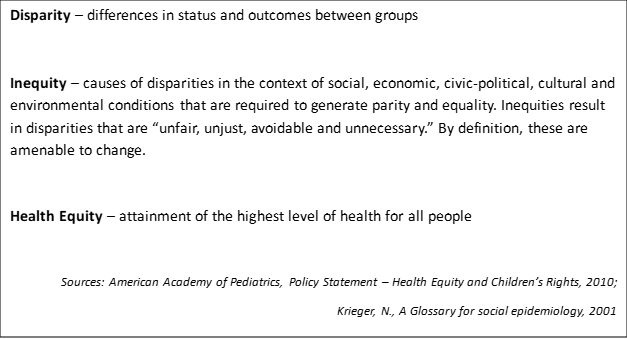
BOX – DEFINITIONS
Genesis Health Consulting is continuously focusing on health equity. What it is. Why it matters. And what we can do to improve it. We do so because it is a critical issue facing American children today that ultimately impacts all of us. Disparities in the health and wellbeing of children are growing, fed by the unchecked inequities in social and environmental drivers of health. The experience of poverty, racism, violence, environmental toxins, isolation, and transience shape the childhood of millions of American children and are often co-associated. Where one exists, others are likely to follow. Without deliberate intervention, these experiences are cyclical and self-sustaining. And they have a devastating effect on our children.
The America a child is born into can be vastly different depending on that child’s race, financial resources, social support, and home environment. In one America, parents and community leaders focus on survival: living to a first birthday, avoiding lead poisoning, drinking clean water, accessing basic health care, managing hunger, securing housing, and the like. In another America, these basic survival needs are assumed, and parents and leaders instead focus on matters of thriving: evaluating school quality, providing enriching experiences for their children, and encouraging healthy food habits and exercise.
These disparities between the societal factors that affect childhood have a direct, measurable, and generational impact on health. If all children were born and raised with the same resources as the second America, researchers estimate that the prevalence of poor health outcomes for children (e.g., low birth weight, intellectual disabilities, psychological problems, abuse) would fall by 60 to 70 percent. Inequities have a particularly devastating effect on children when experienced during pregnancy and in the first few years of life. A child’s quickly developing brain and body are critically vulnerable to these stressors, exposure to which can permanently affect health, quality of life, and expected lifespan.
These differences in lived experience are shaped significantly – sometimes invisibly – by the decisions we make about how our society functions. Some aspects of our society are almost universal, but many more are multidimensional, intensely local and interpersonal. For example, the overwhelming majority of children in America ages five through eighteen attend school. The quality of instruction and resources at that school, the safety of the neighborhood where it is located, and the expectations and assumptions that guide policies and interactions may be vastly different between two schools, even one mile apart. In this one dimension, these differences can have profound consequences for one child. When you calculate it for millions of children across generations, the urgency for change becomes clear.
The remarkable thing is that change is not only possible, but also within our control. Achieving greater health equity starts with public policies that articulate a basic standard for childhood in America. When that standard is not, or cannot be, met, public policy explains how we will close the gap. Health care providers and child health advocates are critical leaders of this effort. As we discussed in previous posts, children need our help ensuring policies consider their potential impact. And when we invest in children’s health, the whole nation benefits – economically, physically, and culturally.
Unsure where to start? Consider these existing programs and policies that improve health equity for our children:
In other posts, we discuss in more detail just how matters of health equity show up in our society, why it should matter to our medical leaders, and how to measure progress along the way.
In the meantime, we want to hear from you. What strategies are most successful in your community for improving health equity? Email us at [email protected].