

States of Change
Understanding readiness for change is key to managing change within a team, department, or organization. A readiness assessment not only helps you understand how colleagues think about change, but also lets you use stage-specific strategies to help people move along their change journey. Several validated tools can serve this purpose. The ADKAR model is one such tool.
In a previous blog post [link to: Change Management: Focus on Who], we briefly described the ADKAR methodology. Essentially, ADKAR assumes people experience change along a continuum: from Awareness to Desire, to Knowledge and Ability, and finally to Reinforcement. These five experiences generally track to three stages of change, as outlined in the figure below.
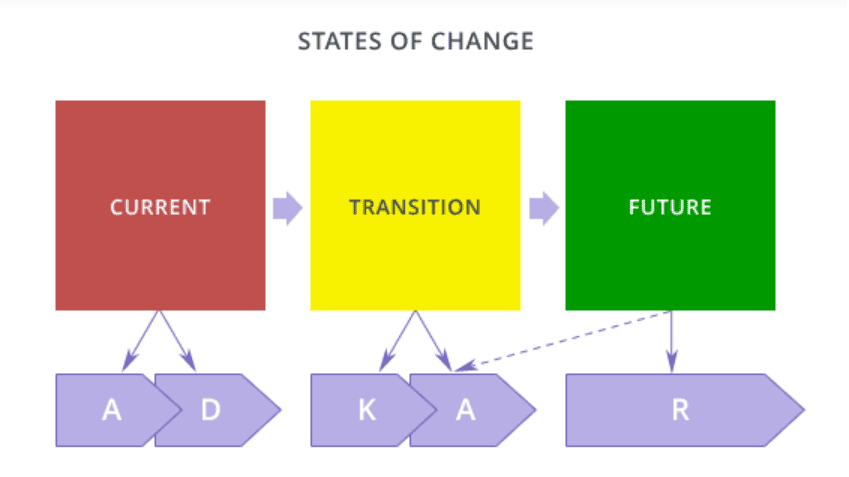
Current State
To move out of the current state and start making a change, the ADKAR model posits that people need to know there is a need for change and want to change.
AWARENESS of the Need for Change
Building awareness of the need for change starts with exploring new perspectives on what might be possible. Our habits and routines are quiet, powerful forces that encourage us to maintain the status quo. The following strategies seek to build this awareness:
- Discussing data that supports change can help build awareness of the need for change.
- Using colleagues or a champion for peer-to-peer conversations may further legitimize the data.
- Some colleagues respond more strongly to an emotional appeal for change; in those cases, stories, pictures, and case studies may be more effective ways to communicate a change opportunity.
DESIRE to Support the Change
Being stuck in this step of the ADKAR model often sounds like, “But this is the way we have always done things.” People may accept that a change should occur, as long as someone else is doing it. The following strategies help to build support for change:
- Consider what motivates each person at this stage, and build motivators into the process.
- Ask leaders to deliver messages that promote a culture of change (e.g., it’s safe to try new things, even if they don’t succeed).
- At this stage, avoid giving people a large number of tasks tied to the change.
- Work with the team to identify whether you can incorporate the change into existing processes to minimize the lift needed to take the first steps.
- Hold listening and discussion sessions to hear people’s concerns firsthand and allow them to express their emotions through questions such as, “What would happen if the change succeeds?” or “What would happen if the change fails?”
Transition State
People may fully support a change they know needs to occur, yet still feel stuck moving forward. This transition state provides the knowledge, skills, and behaviors people need to enable change.
KNOWLEDGE of How to Change
People may know a change is needed and wholeheartedly support it, but they may not understand how to move from where they are to where they need to be. Strategies affiliated with this step work to break down these knowledge barriers:
- Provide education in any new skills that may be required as a result of the change.
- Create roadmaps that break the change into small steps and clearly outline who needs to do what at each step.
- Utilize peer-to-peer coaching and mentoring to share knowledge within and across teams.
ABILITY to Demonstrate the Skills and Behaviors
The step from knowledge to ability is not unlike the step from awareness to desire, in that simply equipping people with knowledge will not immediately transform their skills and behaviors. Strategies here build on knowledge gained:
- Incorporate practice sessions, including role-modeling scenarios, and test equipment and processes so people can practice the new skills and/or behaviors.
- Provide technical support to teams making change through the first several cases incorporating the change.
- Pair team members with differing skill sets to facilitate learning and provide peer coaching and support throughout the change.
Future State
Future state is where the work you’re leading moves away from being “the change” and towards the new “way we do things”. The final step of the ADKAR model reinforces the learnings from the process.
REINFORCEMENT to Make the Change Stick
Even with all of the above, change efforts can stall out if attention is not paid to reinforcing all of the above using the following strategies:
- Celebrate wins, no matter how large or small.
- Set up regular feedback loops to discuss progress, barriers, and change-related data.
- Seek out opportunities to share the process and outcomes with other audiences within the organization.
Genesis Health Consulting has deep experience in change management principles and in co-creating smart, effective and sustainable systems change in support of child health and wellbeing. Email us at [email protected] to learn more about our work in this area.

Next Post:
Previous Post:


