

Change Management: Focus on Who
Many health care organizations develop great ideas for new workflows that are more streamlined; new programs that are going to improve patient health; new contracting mechanisms to promote value. A small specialized team works on developing model pilots, reading research studies, carefully thinking about metrics and data, and determining who is going to do what in the new workflow. Leadership has signed off on the new idea. Resources are allocated to build data capture elements into the electronic health record. The pilot has a go-live date, which comes and goes. A year later, the pilot that leadership was excited about has stopped due to lack of volume.
What happened?
Any number of things could have gone wrong with the project. Do you know what proportion of change efforts fail?
70%.
With all the demand of “healthcare needs to change”, you can understand why healthcare leaders may be averse to change with a statistic like that thereby producing tension. “We know we need to change, but change has a high failure rate, and it is hard.” An important aspect of change that largely either goes unnoticed, or is deprioritized is change management.
What is change management?
Prosci defines change management as “the discipline that guides how we prepare, equip and support individuals to successfully adopt change in order to drive organizational success and outcomes.” In fact, we believe that change management principles are the consistent undercurrent of successfully bringing about change, especially in the healthcare delivery organizations.
One basic idea behind change management is that people are doing the work of the change, be it a new program or new workflow, and if attention is not paid to set people up for success, there is no way the change will be successful. An easy, relatively obvious concept when you read it and one that demands time, attention and resources to execute.
What does successful change management look like?
We’ve already said that people are the key to change management so it is important to consider the “who” in any change scenario.
- Who will be required to change in the new program?
Change will not be successful if the change rests on the shoulders of one person. Multidisciplinary teams need to be brought in to develop the new program from day 1. You may have a subject matter expert who can read literature and speak to what is evidence based, but if the medical assistant and nurse practitioners at the clinic who will be required to change their day-to-day are not present to help shape the change, your change may not be successful.
- Who will the new program serve?
Often new models of care in the healthcare field are designed to improve the care of an important group: Patients. As a result, any change initiative must consider how patients will interact with the change and what it will require from the patients. The new program may require your patients to come to clinic less often, which may initially seem like a great idea, unless you fail to consider that patients who are used to getting reassurance and interaction from their medical team on a regular basis may become more anxious when that regular interaction is changed.
- Who else will be impacted by the change?
We’ve thought about the front-line healthcare staff. We’ve thought about the patients. Who else may be impacted by our project? If we add a new program, how will we bill for it, if we bill for it? Colleagues from revenue cycle and finance can help to inform. How will the EHR need to be changed, or who has access to the EHR need to be modified, to accommodate the program? What are the legal and compliance implications of the change? If we make a change in specialty care, what implications does it have for our patient’s medical home?
In our introductory scenario, bringing together a team of front-line staff, patient representatives, leadership from the clinic and service line areas, subject matter experts, analysts, developers and all others identified through the line of questioning above to co-create a model pilot would be more likely to bring about successful change.
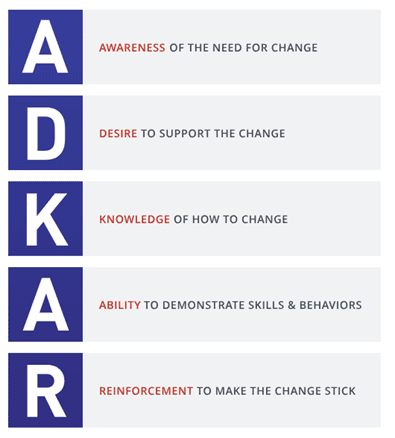
Identifying all of the people necessary to the change is critical and so is figuring out how best to set them up for success. Prosci developed the ADKAR® model to guide change and when used, can help facilitate meeting people where they are at along the change process. Certainly, if the clinic staff are not aware of the need for a change, showing up with a skills training for the new model of care is likely going to be a low-attended training. Alternatively, clinic staff may be very well aware of the need for a change, and may support a change but may not know exactly how to bring about the change. In this scenario, providing tools and resources on how to make the change would be more beneficial than a meeting to talk about why the change is needed.
Focusing on people is one successful element of change management. Genesis Health Consulting has deep experience in change management principles and in co-creating smart effective and sustainable systems change in support of child health and wellbeing. Email us at [email protected] to learn more about our work in this area.
Next Post:
Previous Post:


